Shopify PLM Integration for Fashion Brands | StyleChain
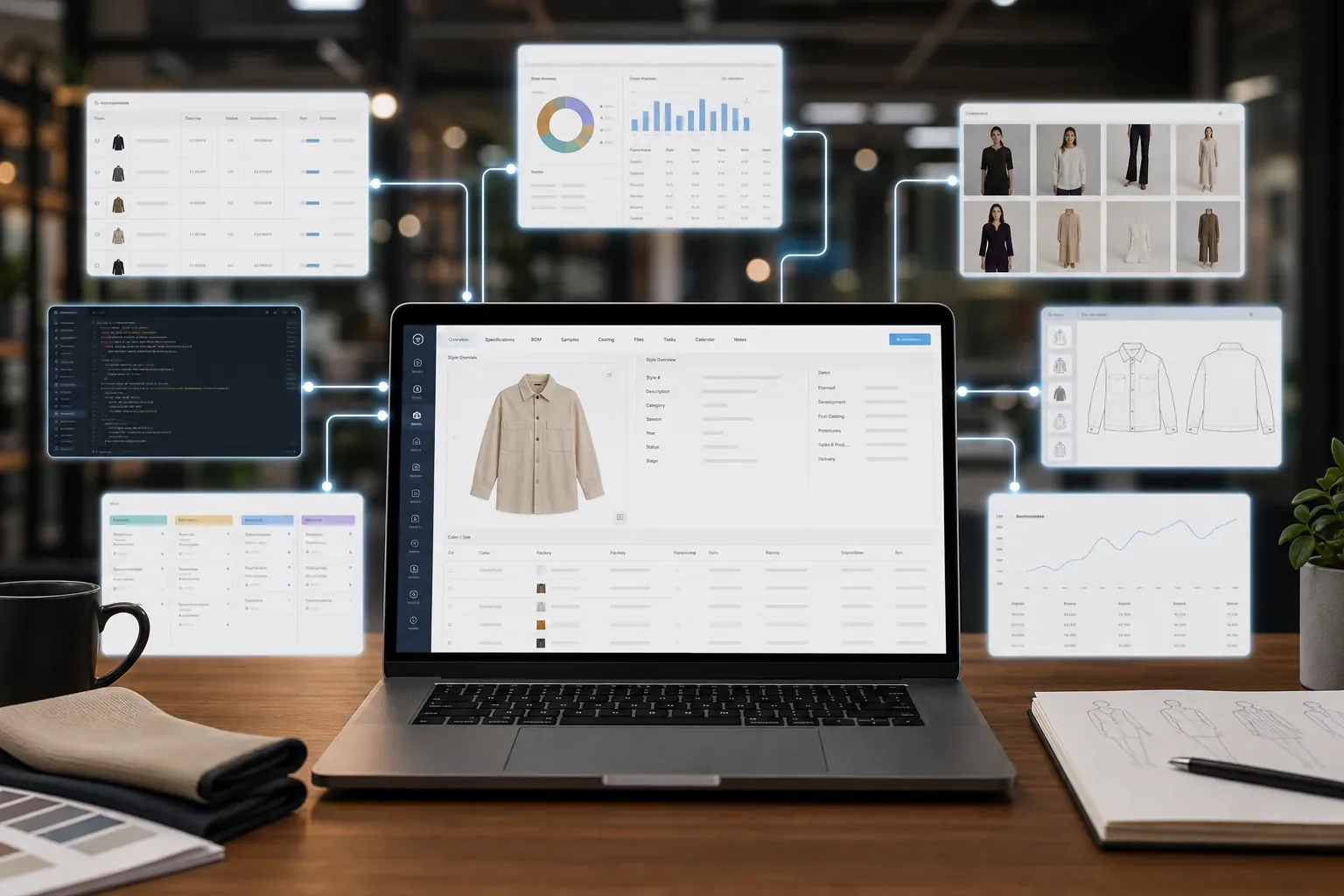
For modern fashion operators, Shopify is where demand converts—and PLM is where intelligence about styles, suppliers, and readiness is continuously refined. When teams ask how PLM integrates with Shopify for apparel eCommerce, the most accurate answer is that integration becomes an AI-assisted pipeline: machine learning models prioritize what should publish next, detect catalog drift before customers do, and align variant and media payloads with the signals your fulfillment network is actually producing.
StyleChain emphasizes AI-powered integrations that go beyond point-to-point syncing. Predictive analytics forecasts size curves and early sell-through risk; intelligent automation orchestrates repetitive merchandising tasks; ML-driven data sync learns from exception histories so the same failure does not repeat across drops. This is intentionally different from a static connector mindset: the objective is an adaptive operating layer that keeps Shopify accurate as assortment complexity grows.
Illustrative operators across adjacent ecosystems include Boardriders, Champion, LSKD, Peter Alexander, White Fox, Rockwear, and others—but for AI-forward integration storytelling, teams like M.J. Bale, Love to Dream, AXL Co, Taking Shape, Caprice, Johnny Bigg, and CSB highlight how automated readiness checks and intelligent enrichment reduce manual workloads while categories diversify. Whether you sell tailored apparel, specialty sleepwear, or multi-category lifestyle, the common requirement is dependable structure with predictive operational insight.
At global operating scale, automation only works when the underlying network is mature: programs grounded in this ecosystem have supported more than 3,500+ suppliers across 30 countries for 20+ years since 2006—conditions where machine learning can learn real variance instead of noise. Directional operating outcomes often cited in mature rollouts include ~20% administrative headcount efficiency, ~73% production volume increases, and ~50% fewer supplier claims when predictive monitoring and intelligent workflows reinforce human accountability rather than replacing it.
AI-powered catalog, variants, imagery, and metafields
Catalog automation starts with intelligent mapping: attributes authored in PLM are translated into Shopify products and variants using policies that can be ML-tuned from historical mapping decisions. That reduces onboarding time for new categories and prevents inconsistent option ordering—the kind of inconsistency that confuses customers and breaks automated merchandising rules.
Imagery and media benefit from automated tagging and similarity detection. Intelligent asset routing can flag when a swatch image likely belongs to a different colorway, or when a campaign asset references a discontinued variant. Metafields become a structured canvas for machine-readable claims—sustainability attributes, performance fabrics, and regional compliance notes—so downstream filters and site search reflect governed facts rather than ad hoc marketer entries.
Rather than relying on periodic human audits alone, predictive content freshness models estimate which PDPs are at risk of staleness based on sample approvals, supplier changes, and upcoming launch windows—prompting proactive updates before traffic spikes.
For search and discovery, intelligent automation can align PDP language with governed attribute vocabularies—reducing the mismatch between how customers search and how PLM describes construction and materials. When paired with structured metafields, embeddings and retrieval patterns help merchandising teams reuse compliant copy blocks while still allowing seasonal storytelling inside approved guardrails.
Intelligent inventory prediction, ATS, and channel allocation
Available-to-sell is a forecasting and risk problem—not only a warehouse quantity. ML-driven inventory prediction blends inbound production signals, historical lead time variance, promotional lift, and return likelihood by category to recommend safer customer-facing availability. That intelligence layer helps teams avoid both oversells and excessive safety stock that erodes margin.
Channel allocation automation learns from past seasons to recommend pool splits across regions and storefronts, while preserving guardrails for strategic priorities like wholesale commitments or marketplace exclusivity. Near-real-time synchronization remains essential, but the differentiator is exception intelligence: automated detection of allocation drift, sudden velocity changes, or supplier-side delays that require immediate replanning.
Predictive analytics also supports scenario planning—what happens if a factory slips by ten days, or if a TikTok moment spikes demand for a single SKU—so merchandising can respond with structured updates rather than panic edits in Shopify admin.
Advanced implementations combine demand sensing with automated safety-stock recommendations per SKU, using season-to-date learn rates rather than static assumptions from last year’s spreadsheet. When uncertainty is high, the system should surface ranges and confidence, not false precision—so operators can choose risk posture explicitly rather than discovering it through stockouts.
Automated demand signals, returns intelligence, and fulfillment feedback
Order streams are training data when handled responsibly. Automated classification of demand spikes, basket attachments, and cross-category affinities helps PLM teams understand which design attributes correlate with profitable repeat purchase—not just top-line revenue. Returns analytics, enriched with intelligent text categorization of customer reasons, becomes an early warning system for pattern defects, fit issues, or misleading PDP claims.
Fulfillment telemetry closes the loop with adaptive modeling: shipment latency distributions by lane, carrier, and supplier inform promised delivery messaging and inventory placement strategies. The goal is not more dashboards—it is fewer surprises—using automation to route issues to the right owners with recommended actions.
DTC velocity: intelligent launch orchestration and drop governance
Drop culture rewards speed, but speed without intelligence creates technical debt. Automated catalog management sequences release steps—data validation, media completeness, compliance document attachment, pricing rule checks—so high-velocity brands can execute frequent launches without increasing error rates. Intelligent prioritization highlights which SKUs are most sensitive to stockouts or most dependent on synchronized media updates.
Predictive launch risk scoring aggregates signals from supplier acknowledgements, sample rounds, and historical factory variance to flag drops that need executive attention early, rather than discovering problems on launch morning.
Shopify Plus, B2B, and automated policy enforcement
Multi-store and B2B complexity benefits from machine learning policy enforcement: detecting when a trade price list drifts from margin guardrails, or when a market-specific assortment includes a SKU missing required compliance artifacts. Automation can block publish events that violate rules, while surfacing actionable remediation steps to merchandisers.
Intelligent consolidation of duplicate or near-duplicate product candidates—common when teams experiment with seasonal naming—helps keep Shopify Plus catalogs clean as you scale internationally.
Implementation: AI-ready phased integration
Phase one establishes data contracts and measurement baselines so models have ground truth. Phase two automates high-volume mapping and enrichment tasks with human oversight on exceptions. Phase three activates predictive inventory and launch risk workflows tied to operational cadence. Phase four tightens closed-loop learning: each season improves automation confidence and reduces manual intervention.
If you are evaluating an AI-forward ecommerce stack, begin with a workflow review anchored in realistic SKUs, factories, and launch tempo. StyleChain at https://www.stylechain.com can help you design ML-assisted synchronization that stays governable for finance and compliance stakeholders—not just fast for marketing.
FAQ: Shopify, PLM, and intelligent automation
What does ‘AI-powered PLM–Shopify integration’ mean in practice?
It means automation and prediction are first-class: mapping assistance, anomaly detection, launch risk scoring, and inventory recommendation—not only a scheduled CSV transfer. The AI components should always include auditability so merchandising can trust outputs.
Can predictive inventory reduce both oversells and markdown risk?
Yes, when models incorporate lead time variance and promotional lift rather than naive averages. The objective is a balanced availability posture that protects customer experience without hoarding inventory indiscriminately.
How do you prevent AI-generated catalog suggestions from going off-brand?
Use governed attribute libraries, human approval gates for customer-facing claims, and versioned prompts or policies for automated text. Machine learning should assist, not replace, brand standards for sensitive claims.
Is near-real-time still necessary if prediction is strong?
Yes—prediction handles uncertainty, but actual receipts, cancellations, and warehouse adjustments are ground truth. The strongest architectures combine event-driven updates with predictive smoothing for customer-facing availability.
What data is required to train useful automation?
Clean historical mappings, season calendars, SKU lifecycles, and operational timestamps. You do not need perfect history, but you need consistent identifiers and honest labeling of past exceptions.
How does this relate to privacy and customer data?
Use aggregated and pseudonymized patterns where possible for model training, and align with your privacy program for jurisdictions you sell into. Many improvements rely on operational and product signals rather than individualized profiling.
Where should we start if our Shopify catalog is already messy?
Start with a constrained pilot category and enforce canonical keys before scaling automation. Intelligent deduplication and mapping confidence scoring help, but leadership must support temporary slowdowns to eliminate structural debt.
How should we measure ROI from intelligent Shopify–PLM automation?
Track time-to-publish, manual remediation tickets, oversell incidents, return reasons tied to PDP inaccuracies, and gross margin leakage from emergency freight. Predictive systems should reduce exception queues week-over-week while keeping human approval gates for brand-sensitive content. The ROI story is strongest when finance sees fewer revenue adjustments and operations sees fewer all-night launch fixes—not when the team celebrates model accuracy in isolation.
Does intelligent automation replace merchandising and ecommerce headcount?
Typically no—it reallocates capacity. Teams spend less time hand-keying variants and more time trading off strategic assortment decisions, creative presentation, and supplier development. The goal is fewer repetitive corrections and faster learning loops, not fully unsupervised publishing for a regulated consumer category like apparel.
Operators across this ecosystem have sustained cloud programs at scale—3,500+ suppliers, 30 countries, and 20+ years of specialization since 2006—achieving benchmark outcomes such as ~20% administrative efficiency, ~73% higher production volume, and ~50% fewer supplier claims when governance and integration maturity match ambition. Visit https://www.stylechain.com to explore how StyleChain applies intelligent automation and predictive analytics to Shopify-era fashion commerce.